B3.1.1 — Gas Exchange as a Vital Function in Organisms
Gas Exchange: The process by which organisms exchange oxygen (O₂) and carbon dioxide (CO₂) between the external environment and their internal tissues, enabling cellular respiration.
Role of Diffusion: Gas exchange occurs by diffusion, where gases move from areas of higher concentration to lower concentration across exchange surfaces.
Large Surface Area in Larger Organisms: Larger organisms need specialized structures (like lungs, gills) to maintain a large surface area to volume ratio for efficient gas exchange. This helps compensate for their smaller surface area relative to their volume.
B3.1.2 — Properties of Gas Exchange Surfaces
Permeability: Gas-exchange surfaces (e.g., alveoli, leaf mesophyll) must be permeable to gases like O₂ and CO₂ to allow diffusion.
Thin Tissue Layer: Gas-exchange surfaces are made of a single thin layer of cells, minimizing diffusion distance for gases.
Moisture: Gases dissolve in moisture, facilitating their diffusion across cell membranes. Moist surfaces in alveoli or leaf cells enhance gas exchange.
Large Surface Area: A larger surface area increases the amount of gas that can be exchanged per unit of time. In humans, alveoli provide a vast surface area for this process.
B3.1.3 — Maintenance of Concentration Gradients at Exchange Surfaces in Animals
Importance of Gradients: Concentration gradients must be maintained so that gases can diffuse efficiently (from high to low concentration). Without this gradient, gas exchange would cease.
Dense Networks of Blood Vessels: Blood vessels ensure oxygen is continuously removed from the gas exchange surface and CO₂ is delivered, maintaining the gradient.
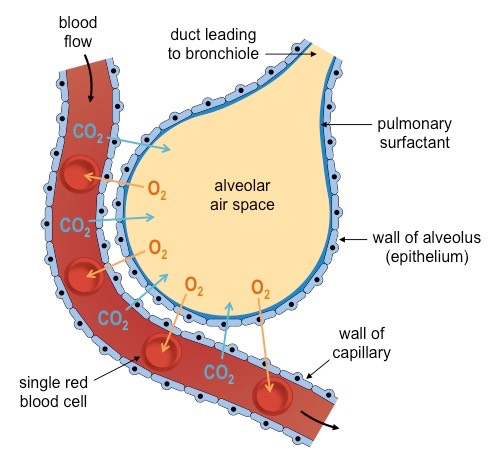
Continuous Blood Flow: Blood flowing through capillaries around the alveoli constantly brings CO₂ and removes O₂, maintaining steep gradients.
Ventilation: In mammals, ventilation (breathing) maintains the oxygen and CO₂ gradients by constantly bringing fresh air into the lungs and removing stale air. In fish, water flows over gills to provide oxygen.
B3.1.4 — Adaptations of Mammalian Lungs for Gas Exchange
Locations of Gas Exchange in Humans: Gas exchange occurs primarily in the alveoli, tiny sacs within the lungs.
Lung Structure:
Alveoli: Small, spherical sacs with thin walls surrounded by capillaries to maximize diffusion.
Capillaries: Dense networks around alveoli provide a large surface area for efficient exchange.
Surfactant: Alveoli are lined with surfactant to prevent collapse and maintain surface area.
The surfectant acts as MOISTURE, which is essential in helping gases diffuse
B3.1.5 — Ventilation of the Lungs
Airway Structure: The trachea connects the lungs to the outside of the body. Air travels from the trachea to the bronchi, bronchioles, and then alveoli.