Parents pass genes to offspring through gametes. Gametes are haploid, meaning they contain one chromosome of each type. When a male and female gamete fuse, their nuclei join, doubling the chromosome number to form a diploid zygote. To produce haploid gametes, parents undergo meiosis, halving the chromosome number in their body cells. This ensures that offspring inherit an equal genetic contribution from both parents. The human life cycle follows this pattern, with 46 chromosomes in body cells and 23 in gametes.
To study patterns of inheritance, scientists cross different varieties of flowering plants. Pollen from the anther of one plant (male parent) is transferred to the stigma of another plant (female parent). This cross-pollination results in fertilization and the production of seeds. The offspring from this cross are called the F1 generation.
To prevent self-pollination, the anthers of the flower can be removed before they release pollen. The flower is then enclosed in a bag to prevent pollen from other plants from reaching the stigma.
Gregor Mendel, a pioneer in genetics, used pea plants to study inheritance patterns. He crossed different varieties of pea plants and analyzed the traits of the offspring. By carefully counting the number of plants with different traits, Mendel was able to discover the basic principles of inheritance.
Different versions of a gene, called alleles, can exist. They may differ slightly or significantly in their DNA sequence. Humans and other diploid organisms inherit two alleles for each gene, one from each parent. Genotypes refer to the combination of alleles an individual possesses.
If an individual has two identical alleles for a gene (e.g., DD or dd), they are homozygous. If they have two different alleles (e.g., Dd), they are heterozygous.
The genotype of an individual determines which alleles they can pass on to their offspring. For example, an individual with the genotype DD can only produce gametes with the D allele, while an individual with the genotype Dd can produce gametes with either the D or d allele.
The phenotype of an organism is its observable traits or characteristics. These traits can be structural, such as hair color, or functional, such as the ability to taste certain flavors. Most phenotypic traits are influenced by both genotype (genetic makeup) and environmental factors.
Some traits are determined solely by genotype, such as ABO blood groups and certain genetic disorders. Other traits, like height and skin color, are influenced by both genes and environmental factors. Environmental factors such as nutrition, sunlight exposure, and temperature can affect how genes are expressed.
Gregor Mendel, considered the father of genetics, used pea plants to study inheritance patterns. He observed that traits like flower color and plant height were inherited in distinct patterns, not blending as previously thought.
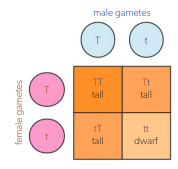
Mendel’s experiments revealed the concept of dominant and recessive alleles. Dominant alleles mask the expression of recessive alleles. For example, in pea plants, the allele for tallness (T) is dominant over the allele for dwarfness (t). A plant with the genotype Tt will be tall because the dominant T allele masks the recessive t allele.
Mendel’s work established the foundation of modern genetics, demonstrating how traits are passed from one generation to the next through the inheritance of alleles.
Phenotypic plasticity allows organisms to adapt to their environment by varying their gene expression and developing traits suited to their surroundings. This adaptation is reversible as it involves switching genes on or off, without altering the underlying genetic sequence. It is particularly useful in heterogeneous environments where conditions can change.