Key Points:
Fragility of Ecosystem Stability:
In essence, the image emphasizes that while some ecosystems have shown remarkable resilience over long periods, their stability is not guaranteed and can be easily compromised by various factors.
There must be a steady supply of energy entering the system and nutrient cycles should not have significant leakages, meaning nutrients should remain within the ecosystem. Secondly, individual species, especially keystone species, must have high genetic diversity. This diversity allows populations to adapt and survive environmental selection pressures.
Several types of environmental change can disrupt ecosystem stability. Harvesting and removal of materials from the environment can disrupt nutrient cycles. Erosion can result in the loss of nutrients. Eutrophication, the nutrient enrichment of a body of water, can cause imbalances in the ecosystem. Selective removal of species, such as through epidemics or poaching, can also disrupt ecosystem structure, particularly if a keystone species is removed.
If the genetic diversity of a population drops below a certain threshold, it becomes less resilient. High biodiversity tends to be associated with stable ecosystems because it provides a robust community structure.
The relationship between climate and ecosystem type is crucial. For example, high rainfall allows for the development of forests, while moderate rainfall supports grasslands. Prolonged changes in precipitation due to climate change can cause ecosystem disruption. There are concerns that changes in rainfall patterns could lead to a tipping point in the Amazon rainforest, causing it to transition from forest to grassland.
Key Points:
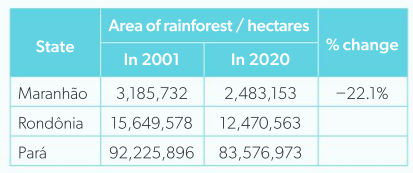
The table in the image shows the area of primary Amazon forest in three Brazilian states in 2001 and 2020. The calculation shows a significant percentage change in forest cover in Maranhão, highlighting the vulnerability of this ecosystem to deforestation.